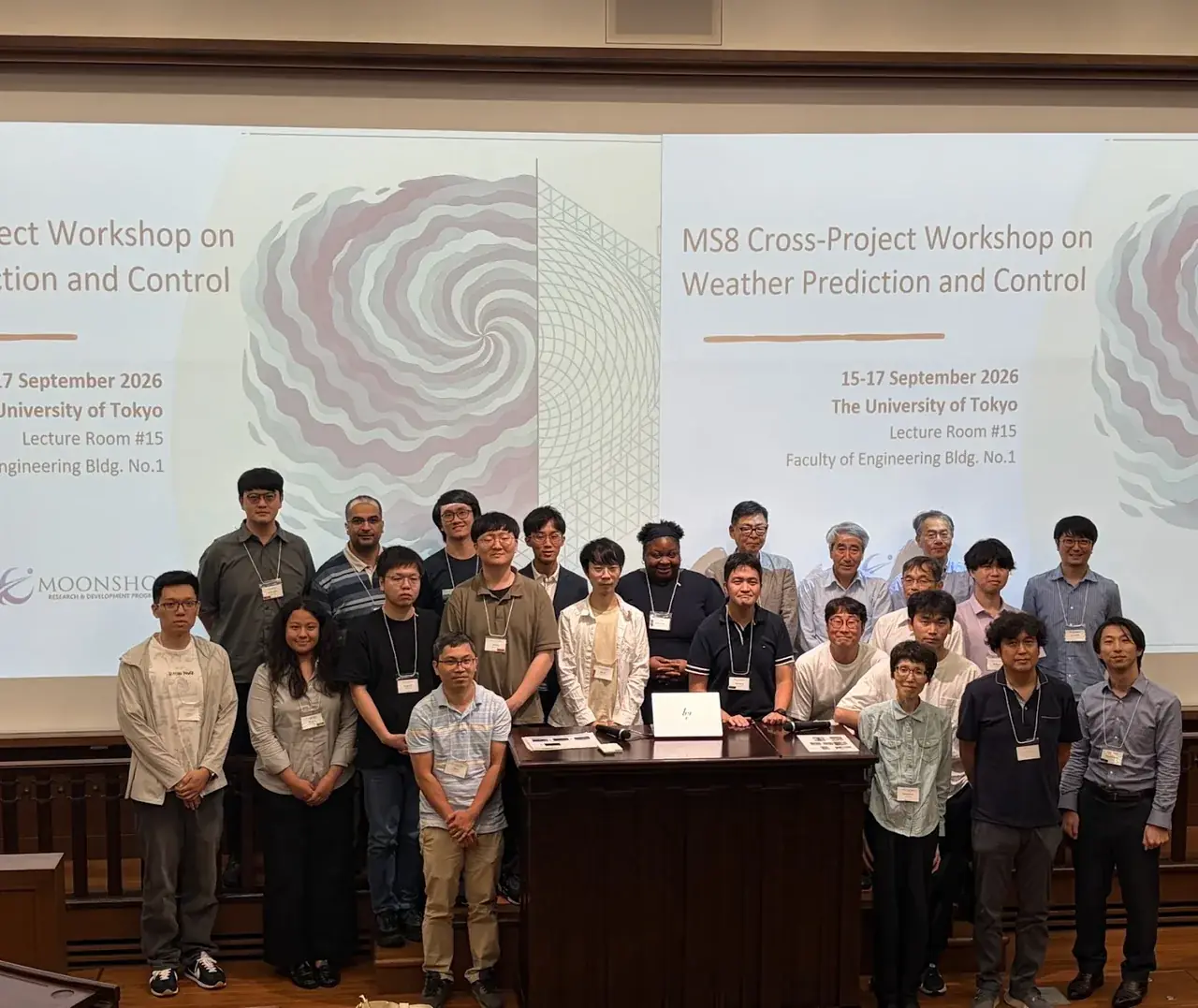
Presented at the MS8 Cross-Project Workshop on Weather Prediction and Control
I presented a real-case SCALE-SDM simulation of the 2012 Kameoka heavy-rain event at the MS8 Cross-Project Workshop in Tokyo, asking what explicit particle-based microphysics adds to the question of weather controllability.
September 17, 2026
I took part in the MS8 Cross-Project Workshop on Weather Prediction and Control, held at the University of Tokyo, Hongo Campus (Faculty of Engineering Bldg. No. 1) from 15–17 September 2026. The workshop is supported by the JST Moonshot R&D Program (Grant Number JPMJMS2281), and brought the Moonshot Goal 8 projects together across three days of talks spanning tropical cyclones, the mathematics of weather control, decision-making, and atmospheric modeling.
My talk in the “Advanced Atmospheric Modeling” session was titled:
Toward weather controllability with explicit microphysics: a real-case SCALE-SDM simulation of the 2012 Kameoka heavy-rain event
Most work on weather controllability so far has leaned on models with bulk microphysics parameterizations, where the droplet and ice populations are represented through assumed size distributions. My talk looked at what changes when the microphysics is made explicit instead — using the Super-Droplet Method (SDM), a particle-based Lagrangian scheme, within SCALE-SDM, and applying it not to an idealized setup but to a real heavy-rain case: the 2012 Kameoka event.
Moving from idealized experiments to a real case is a significant step for this line of work. It means confronting realistic terrain, nested domains at convection-resolving resolution, and observed forcing, all while carrying the substantial computational cost of tracking super-droplets through a full real-case simulation. I presented the simulation design and the first results from this setup, and discussed how explicitly resolved microphysics sharpens the questions we can ask about where, when, and how strongly a convective rainfall system might realistically be influenced.
It was a valuable session for our group in particular — my colleagues from the Shima Research Group presented immediately after me, with Inyeob La on coupling SPRINTARS with the Super-Droplet Method for real-case cloud simulations against EarthCARE observations, and Chongzhi Yin on targeted reconstruction of cloud-particle histories in SCALE-SDM.
Across the three days it was genuinely useful to see the control problem approached from so many directions at once — from AI weather models and ensemble control theory through to evacuation behaviour and socio-economic impact assessment — and to discuss where explicit cloud microphysics fits into that bigger picture.