Presented an oral talk at the JpGU-AGU Joint Meeting 2026
I gave an oral presentation in the 'From Weather Predictability to Controllability' session at the JpGU-AGU Joint Meeting 2026, showing how aerosol-sensitivity experiments with the Super-Droplet Method bridge the gap between predicting and controlling Japanese convective downpours.
May 29, 2026
I was glad to present an oral talk at the JpGU-AGU Joint Meeting 2026 (Japan Geoscience Union – American Geophysical Union), held at Makuhari Messe, Chiba, on May 29, 2026.
My presentation was part of session A-AS11, “From Weather Predictability to Controllability,” which brought together researchers exploring how the chaotic nature of weather can still leave room for small, well-chosen perturbations to grow into meaningful impacts — the central premise behind the idea of “weather controllability.”
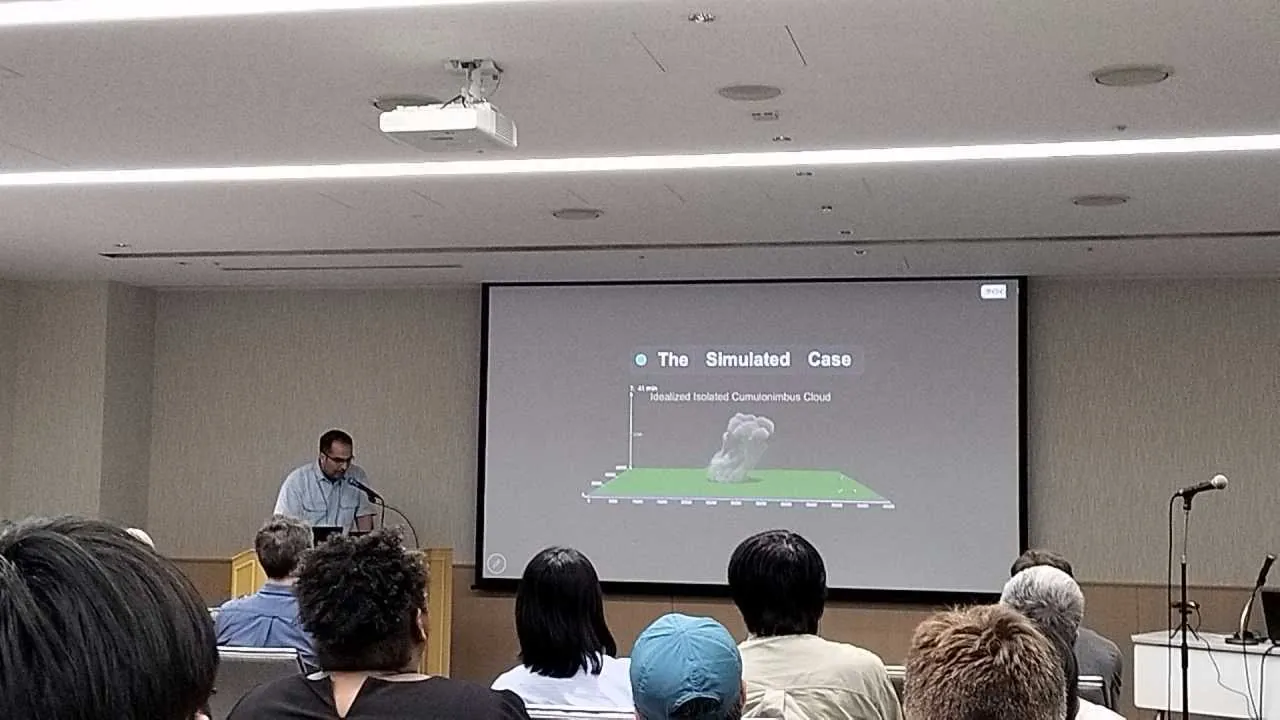
In session A-AS11, I presented:
From Predictability to Controllability in Japanese Convective Downpours: Aerosol-Sensitivity Experiments with the Super-Droplet Method
Manhal Alhilali, Yutaro Nirasawa, Shin-ichiro Shima, Seiya Nishizawa, and Wojciech W. Grabowski
My talk focused on the controllability-relevant sensitivity of Japanese deep convective clouds — the localized, short-duration heavy rainfall often called “guerrilla heavy rain” — to background aerosol conditions. Using the Super-Droplet Method (SDM), a particle-based Lagrangian microphysics framework coupled with the nonhydrostatic model SCALE-SDM, we ran controlled perturbation experiments spanning pristine-to-polluted CCN concentrations and hygroscopicity regimes around a realistic baseline.
We diagnosed how these aerosol changes affect precipitation onset, peak rain rate, accumulation, condensate partitioning, cloud-top height, updraft structure, and the evolving droplet and ice size spectra — and generated synthetic radar reflectivity to link microphysical changes to observable storm signatures. The preliminary results point to nonlinear, regime-dependent aerosol control pathways: increasing CCN systematically delays warm-rain initiation and alters condensate lofting, but the resulting surface rainfall response depends on the dynamic environment and mixed-phase feedbacks.
By identifying the aerosol regimes where convective precipitation efficiency is most sensitive, this work offers process-level guidance toward targeted intervention strategies — a quantitative bridge from weather prediction to practical controllability for urban heavy-rain risk in Japan.
It was a great opportunity to discuss these ideas with the community working at the frontier of weather predictability and control.