Presented at the EU-Japan AI4Good cooperation workshop during Digital Week 2026
I spoke in the AI4Climate session of the EU-Japan AI4Good cooperation workshop, presenting how extreme-scale super-droplet simulations can help clarify aerosol controls on severe convective rainfall.
March 26, 2026
I was pleased to participate in the EU-Japan AI4Good cooperation workshop, held during EU-Japan Digital Week 2026 in Tokyo on March 26, 2026.
The session, “Leveraging Extreme-Scale Computing for Societal Challenges,” brought together researchers, infrastructure leaders, and policy stakeholders to discuss how high-performance computing and AI can contribute to major societal challenges. It was hosted at the Delegation of the European Union to Japan and organised through collaboration involving INPACE, NAISS, RIKEN, and the Juelich Supercomputing Centre (JSC).
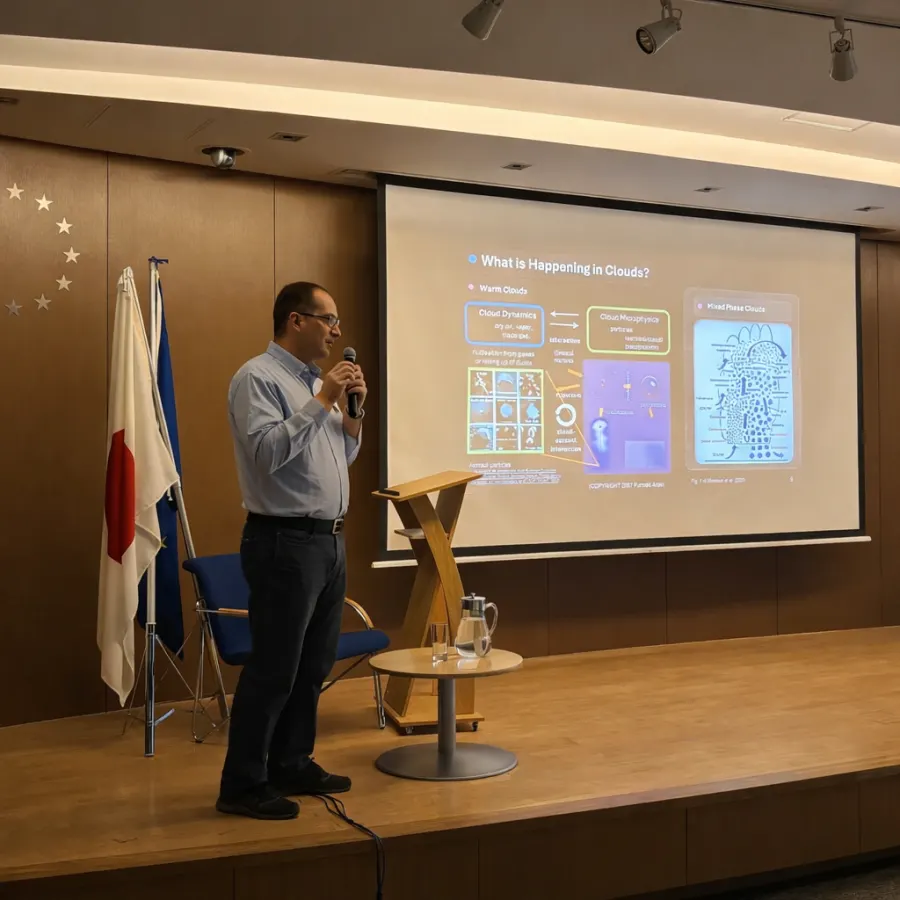
In the AI4Climate session, I presented:
Understanding Aerosol Controls on Severe Convective Rainfall from Extreme-Scale Super-Droplet Simulations
My talk focused on how extreme-scale cloud simulations can help clarify the links between aerosols, cloud microphysics, and severe rainfall. These problems require both physical detail and large computational resources, so this workshop was an especially relevant setting for discussing how HPC and AI can support climate-related research with societal impact.
The program also featured institutional perspectives from Kengo Nakajima (RIKEN), Mathis Bode (German JUPITER AI Factory), and Rossen Apostolov (MIMER / NAISS), together with contributions across AI4Climate and AI4Health, followed by a panel discussion on the future of EU-Japan HPC cooperation under the AI4Good framework.
I was glad to contribute to this exchange and to represent the atmospheric science side of extreme-scale simulation in a broader EU-Japan collaboration setting.