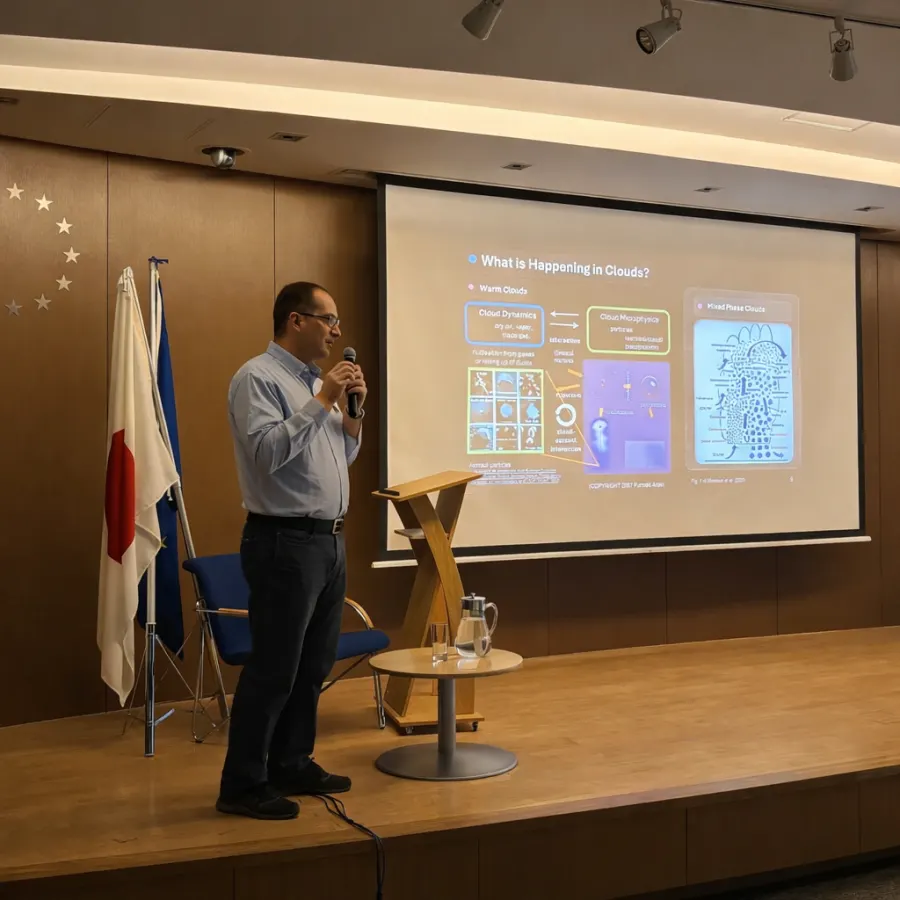
I was glad to participate in the EU-Japan AI4Good cooperation workshop, held during the 2nd EU-Japan Digital Week 2026 in Tokyo.
The session, titled “Leveraging Extreme-Scale Computing for Societal Challenges,” brought together researchers, infrastructure leaders, and policy stakeholders to discuss how high-performance computing and AI can contribute to problems with direct societal impact. It was hosted at the Delegation of the European Union to Japan and organised through collaboration involving INPACE, NAISS, RIKEN, and the Juelich Supercomputing Centre (JSC).
In the AI4Climate scientific session, I presented:
Understanding Aerosol Controls on Severe Convective Rainfall from Extreme-Scale Super-Droplet Simulations
This talk focused on how extreme-scale cloud simulations can help us better understand the links between aerosols, cloud microphysics, and severe rainfall. These processes are difficult to capture with simplified representations alone, especially when the goal is to resolve the chain from microscopic particle interactions to storm-scale consequences.
Using super-droplet simulations at extreme scale, we can examine these aerosol effects with much greater physical detail. That level of detail matters if we want to move beyond broad assumptions and toward a more reliable understanding of how convective rainfall responds to environmental conditions. It also highlights why advanced computing infrastructure is essential for this kind of research.
What I especially appreciated about this workshop was the broader context. The discussions were not only about raw compute power, but about how shared infrastructure, scientific collaboration, and AI-oriented workflows can be combined in a meaningful way across Europe and Japan. For climate and weather research, that matters: these are computationally demanding problems, but they are also international problems.
The program also included institutional perspectives from Kengo Nakajima (RIKEN), Mathis Bode (German JUPITER AI Factory), and Rossen Apostolov (MIMER / NAISS), followed by talks in both AI4Climate and AI4Health, and a panel discussion on the future of EU-Japan HPC cooperation for AI4Good.
I was pleased to contribute to that conversation from the perspective of atmospheric science and extreme-scale simulation. Events like this are valuable not only because they showcase current work, but because they help create the conditions for stronger long-term collaboration between research communities, computing centres, and application domains.
I left the session encouraged by the level of alignment across the participants and by the shared interest in building practical, sustained cooperation around HPC, AI, and societal challenges. I hope this momentum continues and leads to deeper scientific exchange between the EU and Japan in the years ahead.
Comments